Details
DRM: Readium LCP DRM
Weitere Details
Beschreibung
Become a Java wizard with this popular programming guide
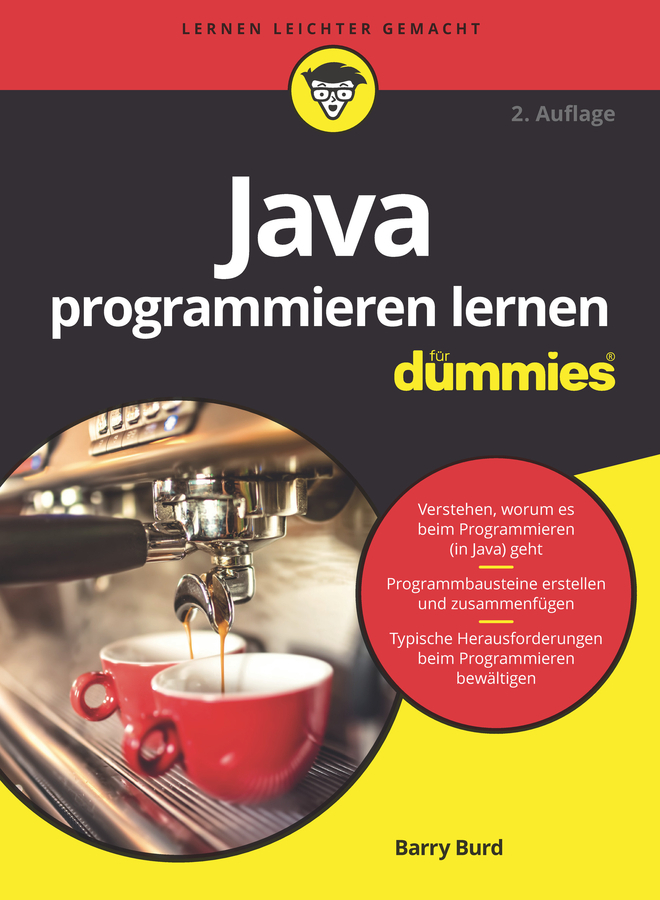
ConsiderBeginning Programming with Java For Dummies your indispensable guide to learning how to program in one of the most popular programming languagesJava! Java is an invaluable language to master, as it's widely used for application development, including Android, desktop, and server-side applications.
Beginning Programming with Java For Dummies is written specifically for newbies to programming. The book starts with an overview of computer programming and builds from there; it explains the software you need, walks you through writing your own programs, and introduces you to a few of the more-complex aspects of programming in Java. It also includes step-by-step examples you can try on your own (and email the author if you need help). As you work through the book, you'll get smart about these Java features:
- Object-oriented programming (OOP), a Java mainstay
- IntelliJ IDEA, an integrated development environment (IDE), that gives you one place to do all your programming, including debugging code
- Loops, branches, and collections
- Variables and operators
- Expressions, statements, and blocks
Beginning Programming with Java For Dummies translates all this foreign programming and computer syntax into plain English, along with plenty of helpful examples and tips. Learning a new languageand coding is definitely its own languageshould be a fun endeavor. With this book as your handy interpreter, youll be on your way to fluency, speaking the language of coders everywhere!
Über Barry Burd
Barry Burd, PhD holds an MS in Computer Science from Rutgers University and a PhD in Mathematics from the University of Illinois. Barry is the author of numerousFor Dummies books, including Java For Dummies andBeginning Programming with Java For Dummies.
Inhalt
Introduction 1
Part 1: Getting Started with Java Programming5
Chapter 1: The Big Picture 7
Chapter 2: Setting Up Your Computer 21
Chapter 3: Running Programs 47
Part 2: Writing Your Own Java Programs 71
Chapter 4: Exploring the Parts of a Program 73
Chapter 5: Composing a Program 95
Chapter 6: Using the Building Blocks: Variables, Values, and Types 127
Chapter 7: Numbers and Types 149
Chapter 8: Numbers? Who Needs Numbers? 173
Part 3: Controlling the Flow 197
Chapter 9: Forks in the Road 199
Chapter 10: Which Way Did He Go? 219
Chapter 11: Around and Around It Goes 251
Chapter 12: Circling Back to Java Loops 275
Part 4: The Inside ScOOP 293
Chapter 13: Programming with Objects and Classes 295
Chapter 14: Using Methods and Fields from a Java Class 315
Chapter 15: Creating New Java Methods 347
Part 5: Smart Java Techniques375
Chapter 16: Piles of Files: Dealing with Information Overload 377
Chapter 17: How to Flick a Virtual Switch 401
Chapter 18: Creating Loops within Loops 423
Chapter 19: Out of Many, One 443
Chapter 20: Oooey-GUI Was a Worm 477
Part 6: The Part of Tens 503
Chapter 21: Ten Useful Classes in the Java API 505
Chapter 22: Ten Bits of Advice for New Software Developers 511
Index 517
E-Book Informationen
Alle hier erworbenen E-Books können Sie in Ihrem Kundenkonto in die kostenlose PocketBook Cloud laden. Dadurch haben Sie den Vorteil, dass Sie von Ihrem PocketBook E-Reader, Ihrem Smartphone, Tablet und PC jederzeit auf Ihre gekauften und bereits vorhandenen E-Books Zugriff haben.
Um die PocketBook Cloud zu aktivieren, loggen Sie sich bitte in Ihrem Kundenkonto ein und gehen dort in den Bereich „Downloads“. Setzen Sie hier einen Haken bei „Neue E-Book-Käufe automatisch zu meiner Cloud hinzufügen.“. Dadurch wird ein PocketBook Cloud Konto für Sie angelegt. Die Zugangsdaten sind dabei dieselben wie in diesem Webshop.
Weitere Informationen zur PocketBook Cloud finden Sie unter www.meinpocketbook.de.
Allgemeine E-Book-Informationen
E-Books in diesem Webshop können in den Dateiformaten EPUB und PDF vorliegen und können ggf. mit einem Kopierschutz versehen sein. Sie finden die entsprechenden Informationen in der Detailansicht des jeweiligen Titels.
E-Books ohne Kopierschutz oder mit einem digitalen Wasserzeichen können Sie problemlos auf Ihr Gerät übertragen. Sie müssen lediglich die Kompatibilität mit Ihrem Gerät prüfen.
Um E-Books, die mit Adobe DRM geschützt sind, auf Ihr Lesegerät zu übertragen, benötigen Sie zusätzlich eine Adobe ID und die kostenlose Software Adobe® Digital Editions, wo Sie Ihre Adobe ID hinterlegen müssen. Beim Herunterladen eines mit Adobe DRM geschützten E-Books erhalten Sie zunächst eine .acsm-Datei, die Sie in Adobe® Digital Editions öffnen müssen. Durch diesen Prozess wird das E-Book mit Ihrer Adobe-ID verknüpft und in Adobe® Digital Editions geöffnet.